 |
| Among the feeble ideas, I jotted down about possible science experiments. |

 |
| During this era, I watched repeatedly Donald's "antagonizes" a series of ants in "Tea For Two Hundred" (1949). As politically incorrect as it was to have the ants depicted as African Americans it was humorous. My favourite part was when the ants throw Donald over the cliff. Beautiful backgrounds from Thelma Witmers and Oliver Wallace music added to what was to have been a serene outing in the mountains for Donald. |
Friday afternoon I went downstairs to the library in order to do some research for an assignment. I was in the middle of reading a book when I heard a familiar sound; upon further inspection, it was Clarence Nash as Donald Duck and Paul Frees as the Narrator. I could not help myself from looking into the classroom where students were watching “Donald Duck and Mathmagic Land”. I did not want to make it look obvious that I was looking into the classroom so I headed upstairs.
I was always excited to play “Capture the Flag” with my classmates, on the “Marion Carson Elementary” soccer field: A perfect topper to the end of the school week. In order not to get trapped by the opposing team, I devised a clever way of maneuvering around them. I would quote the promotional texts from issues of “Uncle Scrooge”. For example, on the cover of issue #62 “Yeeks! Advance To The Rear! IT”S THE QUEEN OF THE WILD DOG PACK”. Classmates would give me a puzzled look as to why I would say that, but that did not matter to me. It served its purpose of distracting the opponents. I madly maneuvered around them. When one classmate was close to catching me I said, “I was the Cannon on the Wabash Cannonball” as I ran rampantly from their clutches. You are probably wondering where I had come across this quotation.
A couple of days earlier, my friend Joey had lent me his issues of “Uncle Scrooge” (285-297) that printed “The Life And Times of Scrooge McDuck”. Each installment of “Life and Times” would be accompanied by a commentary where Don Rosa explained the historical events he used or references that Carl Barks inferred to about Scrooge’s past. Therein would lay panels from “Uncle Scrooge” stories. It was a treat for me, as I had not read most of his adventures. Don Rosa did a gargantuan feat of using the few references that Carl Barks made to Scrooge’s past and create a great series. I had a better appreciation of the battles Uncle Scrooge triumphed over when he was attaining his fortune. We were introduced to his family – his parents, uncle’s, and sisters. When I returned to class that Monday. I was working at my desk when I saw Mr. Pugh pushed a TV trolley in the classroom. I leaped out of my desk when seeing the cover of “Donald Duck and Mathmagic Land”. It was a thrill viewing the cartoon as I had seen only pictures of it. A nifty cartoon that combined math concepts with my interest. After we played soccer, my friend Ian had arrived from a dentist appointment, he asked me what he missed in class. My friend Spencer said that we watched an Uncle Scrooge cartoon, and I corrected him that it was Donald. One thing that irked me at that time was how people would confuse Uncle Scrooge with Donald.

Each night I would unwind by reading a chapter from "The Life and Times of Scrooge McDuck". It was “Chapter 11: The Empire Builder From Calisota” that I found to be the most intriguing as his personality shifted to the hardened, villainous character he was when Barks first introduced him to the world. I found it heart wrenching how once he accomplished his goal of being the richest Duck he loses his family. I thought had he not made that immoral decision in securing his position of the wealthiest. Would it have resulted in him in cutting all ties with his family?
We went to the school library to select a book for quiet reading. This one day we had a found a book on the planet Uranus. You can guess the pre-pubescent humor we reviled in. Yes, we were fascinated with the word – Uranus. We purposely read out the name “Uranus” and laughed relentlessly at the name of the planet.” Another session of giggling erupted when asked Mr. Pugh what we were reading, we told him Uranus.
For an inexplicable reason I or one of our classmates brought out “The Sesame Street Dictionary” from the bookshelf. Although the subject was beyond our age level nonetheless we found it interesting. I was amazed by the diverse cast of characters featured in the book from the popular (Ernie, Bert, Oscar, Big Bird, Cookie Monster, Grover, and Kermit the Frog) to the obscure (Guy Smiley, Prarie Dawn, Sherlock Hemlock, Herry Monster, and Don Music) In first grade I signed out the book but I was perplexed how there was no narrative. We discussed a rumor of Bert being killed off.
When we went back to class Ian and I searched for supplies in Mr. Pugh’s cabinet, we discovered a video – “Disney Sing-Along Songs: Under the Sea”.We shared our find with a group of classmates who were curious about what we were giggling about. The video reminded us of the eponymous song which was lampooned in “Homer Badman” where Homer imagined living underwater. It led to a couple of us singing Homer's rendition of "Under The Sea". By the end of the day, my stomach ached from ceaseless caterwauling.
On February 5, 2004, we presented our projects once in front of our class. When it was my turn to talk about my project “Bouncing Balls”, Jare one of my classmates asked Adel how far did your balls bounce? Once he said that I could not contain my composure. We presented in the gymnasium after recess and later in the evening. It would be a few weeks later until we would discover who would be the representatives of the Calgary Youth Science Fair, but I was preoccupied in enjoying the "The Life and Times of Scrooge McDuck".
Out of good conscience, I couldn't keep Joey's comics for a long time. The night before I had to return the comics Joey lent me I was reading “Chapter 8C: Hearts Of The Yukon”. I remember listening to “Desperado” by the Carpenters as I read the story. The song aptly fit the faltering relationship between Scrooge and Goldie. The final lyric “You better let somebody love you, before it’s too late,” supported the notion of how Scrooge was to reveal his desire for Goldie in the burning Blackjack Saloon before being knocked unconscious from a fire hose. It was a bittersweet moment as I could not wonder what would have prospered had he conveyed his feelings towards her. I preferred their relationship over Donald and Daisy’s as their relationship was one-sided. The fact that they both had rigid hearts and could not openly display their affection was appealing. Don Rosa could be more explicit with how he handled their relationship, as he did not have to deal with the confines of censorship.
The interplay between the lethargic Donald as he struggled to carry a crotchety Scrooge on his back while climbing the Chilikoot Pass was witty. It was similar to the beginning of “McDuck of Arabia” (US#55) where he was excited in tossing moneybags, while Donald was intent on sitting on a chair. A few months later, I was having a conversation with my tutor who was from British Columbia. I asked her if she had seen the Chilikoot Pass? She told me she had. After she left, my mom asked me how did I know of the Chilikoot Pass? I told her I learned about it from “Back To The Klondike”. The story is still enjoyable as when I read it in my formative years.

A couple of days later the list of qualifiers of the Calgary Youth Science Fair was posted outside Mr.Pugh's classroom. I remember how I made my way through the sea of 'grade sixers' to see if I made it. I scrolled down through the list with my finger and I saw my name listed there. Then as I was leaving I went back to check that it was actually my name. There it was! I was awestruck that I was among the many contenders along with Ian, Spencer, and many others. One of my friends Jamie he was heartbroken that his project was not selected to win. I felt guilty about having been one of the contenders as it wasn’t my intention to have been a part of it.
There was the day I wanted to borrow a VHS entitled “Donald Duck: Kids Is Kids”. The cover was a still from 1952 short "Lucky Numbers" or as I called it "the one that takes places at a gas station".
I called all branches of “Rogers Video” to see if they carried the video. I was disappointed that none of the locations had it. The following day I walked to the library, to pay Joey a visit and ask him if I could borrow one of his volumes of "The Carl Barks Library". On the way there I had a longing for a Duck related surprise if it was a comic book or videocassette.
When I arrived at the library I went to the reception to talk to him. We had a brief conversation before he asked to be excused, which I allowed. At the age, I was not aware that our discussions may be distracting him from completing his work. I treasured our discussions about Carl Barks and other Disney artists. I would occasionally bring the subject about the Ducks up with my friends, but they did not share the level of enthusiasm as I did. Remember this was before I entered the world of blogs and forums, so I did not have anyone to discuss deeply the topic. When Joey returned he held a copy of "Walt Disney's Comic Digest" #44. Upon seeing the comic I did a "take" that exaggerated a Tex Avery cartoon. He explained how he found a spare copy while cleaning out his house. I was eternally grateful for him giving the comic to me.

 |
| The scene where a distraught Donald observes his transformation into Alice of Wonderland fame is the moment I saw the film. |
A couple of days earlier, my friend Joey had lent me his issues of “Uncle Scrooge” (285-297) that printed “The Life And Times of Scrooge McDuck”. Each installment of “Life and Times” would be accompanied by a commentary where Don Rosa explained the historical events he used or references that Carl Barks inferred to about Scrooge’s past. Therein would lay panels from “Uncle Scrooge” stories. It was a treat for me, as I had not read most of his adventures. Don Rosa did a gargantuan feat of using the few references that Carl Barks made to Scrooge’s past and create a great series. I had a better appreciation of the battles Uncle Scrooge triumphed over when he was attaining his fortune. We were introduced to his family – his parents, uncle’s, and sisters. When I returned to class that Monday. I was working at my desk when I saw Mr. Pugh pushed a TV trolley in the classroom. I leaped out of my desk when seeing the cover of “Donald Duck and Mathmagic Land”. It was a thrill viewing the cartoon as I had seen only pictures of it. A nifty cartoon that combined math concepts with my interest. After we played soccer, my friend Ian had arrived from a dentist appointment, he asked me what he missed in class. My friend Spencer said that we watched an Uncle Scrooge cartoon, and I corrected him that it was Donald. One thing that irked me at that time was how people would confuse Uncle Scrooge with Donald.
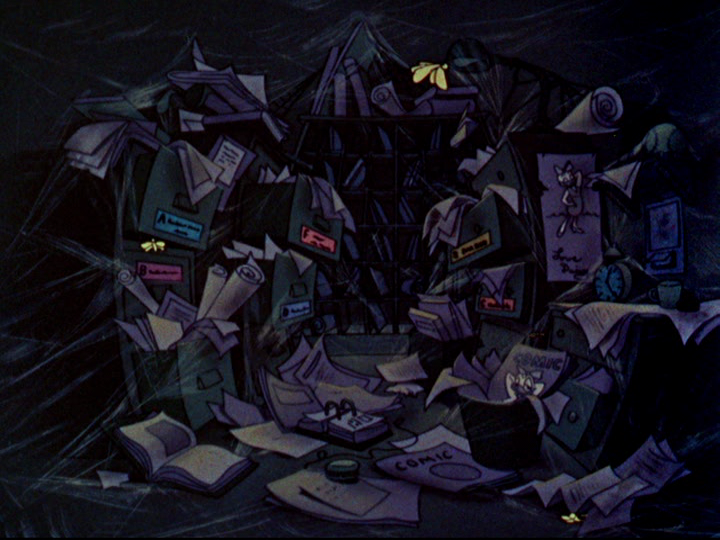 |
| The Narrator (Paul Frees): Look at the condition of your mind: antiquated ideas! Bungling! False concepts! Superstitions! Confusion! To think straight, we'll have to clean house. A pin-up drawing of Daisy(!) in Donald's mind. I always felt this was a reflection of my mind as I had difficulty in school, but I recalled inane knowledge about my interests. I visualized this scene of when I needed to focus on complex concepts in class. |

 |
| The background artists imaginatively incorporated numbers in the background. |
Each night I would unwind by reading a chapter from "The Life and Times of Scrooge McDuck". It was “Chapter 11: The Empire Builder From Calisota” that I found to be the most intriguing as his personality shifted to the hardened, villainous character he was when Barks first introduced him to the world. I found it heart wrenching how once he accomplished his goal of being the richest Duck he loses his family. I thought had he not made that immoral decision in securing his position of the wealthiest. Would it have resulted in him in cutting all ties with his family?
We went to the school library to select a book for quiet reading. This one day we had a found a book on the planet Uranus. You can guess the pre-pubescent humor we reviled in. Yes, we were fascinated with the word – Uranus. We purposely read out the name “Uranus” and laughed relentlessly at the name of the planet.” Another session of giggling erupted when asked Mr. Pugh what we were reading, we told him Uranus.
For an inexplicable reason I or one of our classmates brought out “The Sesame Street Dictionary” from the bookshelf. Although the subject was beyond our age level nonetheless we found it interesting. I was amazed by the diverse cast of characters featured in the book from the popular (Ernie, Bert, Oscar, Big Bird, Cookie Monster, Grover, and Kermit the Frog) to the obscure (Guy Smiley, Prarie Dawn, Sherlock Hemlock, Herry Monster, and Don Music) In first grade I signed out the book but I was perplexed how there was no narrative. We discussed a rumor of Bert being killed off.
 |
| A sample of the layout of "The Sesame Street Dictionary". |
When we went back to class Ian and I searched for supplies in Mr. Pugh’s cabinet, we discovered a video – “Disney Sing-Along Songs: Under the Sea”.We shared our find with a group of classmates who were curious about what we were giggling about. The video reminded us of the eponymous song which was lampooned in “Homer Badman” where Homer imagined living underwater. It led to a couple of us singing Homer's rendition of "Under The Sea". By the end of the day, my stomach ached from ceaseless caterwauling.
On February 5, 2004, we presented our projects once in front of our class. When it was my turn to talk about my project “Bouncing Balls”, Jare one of my classmates asked Adel how far did your balls bounce? Once he said that I could not contain my composure. We presented in the gymnasium after recess and later in the evening. It would be a few weeks later until we would discover who would be the representatives of the Calgary Youth Science Fair, but I was preoccupied in enjoying the "The Life and Times of Scrooge McDuck".
Out of good conscience, I couldn't keep Joey's comics for a long time. The night before I had to return the comics Joey lent me I was reading “Chapter 8C: Hearts Of The Yukon”. I remember listening to “Desperado” by the Carpenters as I read the story. The song aptly fit the faltering relationship between Scrooge and Goldie. The final lyric “You better let somebody love you, before it’s too late,” supported the notion of how Scrooge was to reveal his desire for Goldie in the burning Blackjack Saloon before being knocked unconscious from a fire hose. It was a bittersweet moment as I could not wonder what would have prospered had he conveyed his feelings towards her. I preferred their relationship over Donald and Daisy’s as their relationship was one-sided. The fact that they both had rigid hearts and could not openly display their affection was appealing. Don Rosa could be more explicit with how he handled their relationship, as he did not have to deal with the confines of censorship.
 |
The lyric "Don’t your feet get cold in the winter time?” alludes to how Scrooge’s imperceivable fortitude conquers the frigidness he is experiencing, while visiting Glittering Goldie. The set of lyrics "The sky won’t snow and the sun won’t shine. It’s hard to tell the night time from the day" describes the constant bleakness as he was making his way through the storm.In the lower panel, you can sense the struggle he is putting up against the storm by his gesture. Don Rosa's drawing makes you feel as you are battling the elements with him. The colours of blue and purple add to the coldness.
|
 |
| Scrooge's hallucination of Goldie as a reindeer was humorous, yet odd. |
 |
| The lyric "Your prison is walking through this world all alone" is applicable to both Goldie and Scrooge as they both have put up walls preventing each other from being hurt. In the final tier, Don Rosa through different perspectives conveys how they both feel the same loss. |
Sadly I had to return the issues that I had borrowed from Joey. It was “Valentine’s Day” that I picked up “Uncle Scrooge” #325 as it reprinted, Carl Barks classic “Back To The Klondike”. I never owned a copy of the comic. A frequent writer to the Uncle Scrooge letter column, Joe Torcivia, commented: ”Like a cherished holiday TV special, [“Back To The Klondike”] should return regularly to thrill each new crop of readers,” which conveyed my sentiment. I read the story online with my dad, however, it was not the same experience. The tale included the infamous scene of him recalling what happened between him and Goldie. I was enamored with how Glittering Goldie drugged his coffee in order to obtain the Golden Egg Nugget. How he inflicted over the top violence upon the locals in the bar was fantastic.
Carl Barks looking back on the morality of the scene said: " Scrooge picked her up and carried her out to his claim and made her go to work. It didn't look like kidnapping, yet it was. He was taking the law into his own hands and that is not lawful. And what did he do with her at night?” My interpretation was there were platonic undertones to their relationship. What was great was how he stirred up interest of what may have happened during the stint without going too much into detail. I had no qualms about the young Scrooge kidnapping Goldie being unethical. At that age, it was cool seeing him as an antihero, as you saw Goldie withering in her ripped clothes and tousled hair. Ha-ha-ha I loved this sequence so much it's scary! The DUCKTALES adaptation of the story appropriately altered the incident of Goldie willingly offer Scrooge to replace his nugget. For further reading on the adaptation, I HIGHLY recommend Chris Barat’s analysis.
 |
| It was ironic that at the time in Calgary, Alberta there was deep snow, which matched the panel of Scrooge surrounded in a snowdrift. White Agony Creek was reminiscent of the scenery in Calgary. It made me appreciate the great lengths Carl Barks went to make sure the backgrounds were accurate to the story’s setting. |
 |
| His style during this period was nice. As the characters had a 'soft' look to them. The censored pages include a gamut of emotions from scorn, seductiveness, and sorrow were striking that I traced many poses from here. |

 |
| The Marion Carson School Newspaper announcing the City Science Fair. |
 |
| That ride from school I proudly told my mom that I would be participating in the Calgary Youth Science Fair evoked this page from Don Rosa's "The King Of The Klondike. In the second tier, the secession of expressions as Scrooge's mood elapses from contemplation to greed was captured marvelously. |
I called all branches of “Rogers Video” to see if they carried the video. I was disappointed that none of the locations had it. The following day I walked to the library, to pay Joey a visit and ask him if I could borrow one of his volumes of "The Carl Barks Library". On the way there I had a longing for a Duck related surprise if it was a comic book or videocassette.
When I arrived at the library I went to the reception to talk to him. We had a brief conversation before he asked to be excused, which I allowed. At the age, I was not aware that our discussions may be distracting him from completing his work. I treasured our discussions about Carl Barks and other Disney artists. I would occasionally bring the subject about the Ducks up with my friends, but they did not share the level of enthusiasm as I did. Remember this was before I entered the world of blogs and forums, so I did not have anyone to discuss deeply the topic. When Joey returned he held a copy of "Walt Disney's Comic Digest" #44. Upon seeing the comic I did a "take" that exaggerated a Tex Avery cartoon. He explained how he found a spare copy while cleaning out his house. I was eternally grateful for him giving the comic to me.
 |
| Upon walking home, I was mesmerized by Tony Strobl's drawing and the clever caption. I always liked the layout of the digest's cover with a Disney character in the corner. |
The quality of the digest was not in the greatest of shape, but I treasured it nonetheless. I got a real kick of seeing the stories muddily-reproduced in the digest. There were two stories "Donald Duck In Ancient Persia" and "The Pixilated Parrot" I had never read before. The covers that originally followed the stories were also reprinted. "Donald Duck In Ancient Persia" was the first story of his where I was really riveted.
The scientist is an actual human being added to the chill factor. The scientist’s elixir, when invoked upon on human ashes, brought people to life fascinated me. What was even more foreboding was how he abducted the Ducks. That’s a joke, son! King Nevvawaza poked the scientist in the eye as he repeatedly asked about how his people were desiccated, reminded me of when Moe would inflict it upon Larry or Curly. His illustrations of the characters drying up were spooky.
In "Donald Duck and The Pixilated Parrot" his gesture of giving Uncle Scrooge the parrot as a birthday present was thoughtful. Scrooge's reaction ("Me with a bird to support. I should give myself to the poor farm.) was priceless as he refused his nephew's present. The hi-jinx the parrot present as he endlessly enumerated numerous items was a good running gag. It was strange seeing his money stored in a vault inside a building instead of his Money Bin. I found it humorous how Scrooge had to kick Donald in order to persuade him to retrieve the parrot from a flagpole. I thought that the story was finished once they brought Polly from the jungle. I forgot about the robbers who stole his money. How it took them an entire month to split the money between them.
On Thursday, March 20 during the last class of the day we played games outside. As we were representatives of our school Mr. Pugh told us to be on our best behavior. It felt as if we were embarking on a secret mission and our duty was to uphold the trust. As I left the building I was on top of a euphoric high that I could not be knocked off from. It felt special attending the City Science Fair while our classmates were in school. The feeling of being away from Marion Carson Elementary even for a day appealed to more.
That night we ordered from Pizza Hut; The leftover pizza slices were my lunch for the next day. It's the only food that can be tasty whether cold or warmed. On Friday, March 21 I went with Ian and Spencer with another participant's father driving us to the Big Four Building. It felt like we were on the cusp of adulthood where we didn't need adult supervision as we went from one booth. I was excited to discuss my project with the judges that would pass by.
 |
| The opening panel of the nephews looking at the ruins of Persia set the foreboding atmosphere. |
 |
| It was eerie how Prince Cad Ali Cad left alone in the bewildering present, happily commits suicide. Barks revisited the concept of a character using powders to return to his former life in 1967’s “King Scrooge The First”, his last story written but drawn by Tony Strobl. |
 |
| After all, Donald endured, he was kind to his nephews it made the story upbeat. |
 |
| Later the evening, I went for dinner at "Pizza Hut". I looked at the final page before our order arrived. I was anxious that we would not have to wash dishes in compensation for payment as the Ducks did. Thankfully we did not! |
That night we ordered from Pizza Hut; The leftover pizza slices were my lunch for the next day. It's the only food that can be tasty whether cold or warmed. On Friday, March 21 I went with Ian and Spencer with another participant's father driving us to the Big Four Building. It felt like we were on the cusp of adulthood where we didn't need adult supervision as we went from one booth. I was excited to discuss my project with the judges that would pass by.
I flipped through "Walt Disney Comic Digest" #44 and "Carl Barks Library I" book 1 was how I passed time. If I was bored I would visit Ian and Spencer. A booth sponsored by APEGA who distributed stickers made me proudly exclaim to my friends how my father was a member of the organization. Ian's mother picked us up from there and we stopped by Roger's Video because Ian wanted to watch a film as he had a basketball game the following day.
 |
The back cover from "Bugs Bunny - Truth or Hare". As mentioned in a previous post I enjoyed looking at the cover art of the video cassettes at Roger's Video. I was intrigued with which short the still of Bugs Bunny as Groucho Marx belonged to. |
 |
| An energetic participant in front of his project. |


.png&container=blogger&gadget=a&rewriteMime=image%2F*)


.png)




.png)
.png)
.png)


.png)

